
Neurofeedback Mechanism Demystifying EEG Biofeedback Beyond Placebo Effect Claims
Electroencephalographic (EEG) neurofeedback—also called EEG biofeedback—is a form of training in which people receive real-time information about measured brain activity and practice changing a selected signal. It is not simply a placebo, because researchers can measure the EEG signals being trained and compare outcomes with sham or active controls. But measurable brain change does not, by itself, prove that neurofeedback reliably treats a condition: results depend on the protocol, outcome, study quality, and comparison group. Understanding the mechanism therefore means separating signal measurement, learning, and clinical benefit, while weighing both promising findings and unresolved evidence.
EEG neurofeedback mechanisms and the brain signals they train
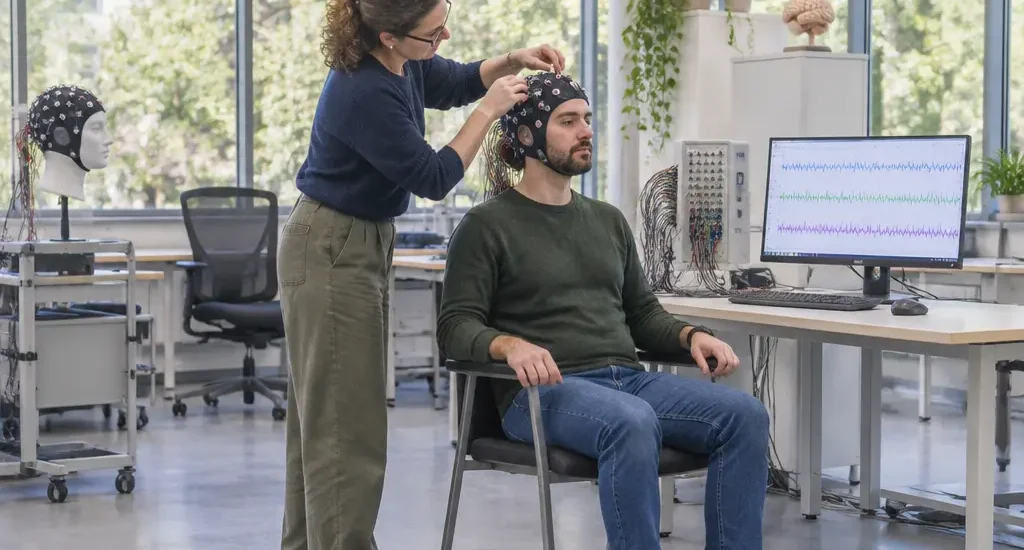
EEG neurofeedback is a closed-loop training method: sensors record electrical potentials at the scalp, software estimates selected features, and a display or sound provides feedback contingent on those features. The International Society for Neuroregulation and Research describes neurofeedback as a learning process in which feedback about brain activity is used to help a person regulate that activity. The signal is an indirect, spatially blurred measurement of synchronized neural activity—not a direct reading of thoughts, a single brain region, or a diagnosis.
The causal idea is straightforward but not fully settled. If feedback is consistently linked to a target EEG feature, a learner may discover actions or mental strategies that shift it; repeated practice may then make that regulation more accessible. Yet the visible feedback can also reinforce attention, relaxation, expectancy, or other strategies, and those may contribute to improvement independently of the specific EEG target. A genuine physiological response and a nonspecific therapeutic effect can occur together.
The EEG features used as training targets
Protocols may train frequency-band power, ratios between bands, sensorimotor rhythm, or amplitudes linked to particular scalp locations. For example, sensorimotor-rhythm training commonly targets activity around 12–15 Hz over sensorimotor regions, while some attention protocols aim to alter the theta-to-beta power ratio. These are protocol conventions, not universal biomarkers: the same frequency can have different meaning depending on location, task, age, and signal-processing choices.
EEG is vulnerable to eye movements, muscle tension, movement, and electrical interference. A change in the displayed target can therefore reflect altered neural activity, artifact, or both. Reliable systems use artifact monitoring and appropriate signal processing, and reports should specify electrode placement, reference, frequency bands, thresholds, and feedback rules. Without these details, a claim that a protocol “trained the brain” is difficult to evaluate or reproduce.
Operant learning, feedback, and self-regulation
Operant conditioning is one proposed learning mechanism: when a target signal meets a criterion, the person receives a reward such as a progressing animation or pleasant sound. Over repeated trials, rewarded patterns may become more frequent. The learner might use imagery, breathing, focused attention, or another strategy, but the successful strategy can vary between people and sessions.
A feedback loop is not proof that a specific neural mechanism caused a clinical benefit. Demonstrating target engagement requires evidence that the intended signal changed beyond measurement noise; demonstrating clinical efficacy additionally requires a meaningful improvement compared with a credible control. Studies may find one without the other. Blinding participants is challenging because people can often tell whether feedback appears responsive, which makes expectancy and treatment credibility important design concerns.
Neurofeedback clinical evidence and the placebo question
The placebo question is best treated as a comparison question, not a choice between “real” and “imaginary.” Improvements can arise from a protocol-specific effect, expectations, therapist attention, repeated practice, natural symptom fluctuation, or concurrent care. A sham-feedback control—where participants receive feedback not contingent on their own target EEG—can help estimate the added value of contingent training, although sham designs also have limitations and can be difficult to keep credible.
ADHD: a prominent test case
Attention-deficit/hyperactivity disorder (ADHD) is one of the most studied applications. Protocols have often aimed to reduce theta activity relative to beta activity or reinforce sensorimotor rhythm. In a 2020 meta-analysis of randomized controlled trials, Westwood and colleagues found that neurofeedback did not significantly improve probably blinded ratings of ADHD symptoms overall, although effects were more favorable in some analyses of established protocols and outcomes measured by people closer to treatment. The difference between blinded and unblinded ratings matters: it suggests that expectations or context may affect reported benefit, while not proving that every protocol is ineffective.
The European ADHD Guidelines Group’s 2024 review, published in the Journal of the American Academy of Child & Adolescent Psychiatry, likewise emphasizes evaluating outcomes under blinded assessment and distinguishing neurofeedback protocols rather than treating them as one intervention. For families, the practical implication is to ask which protocol is proposed, what outcome is being measured, how progress will be assessed independently, and whether established ADHD care will continue. Neurofeedback should not be presented as a guaranteed replacement for evidence-based treatments.
Other applications and evidence boundaries
Researchers have studied neurofeedback for epilepsy, anxiety, depression, post-traumatic stress, insomnia, chronic pain, and performance training. Findings vary substantially by condition and protocol. For example, a reduction in seizure frequency reported in a small or uncontrolled study is not equivalent to a confirmed treatment effect from replicated, well-controlled trials. Likewise, improved performance on a laboratory task does not automatically establish durable benefit in daily life.
A useful evidence hierarchy distinguishes feasibility, target engagement, symptom improvement, and comparative effectiveness. Feasibility asks whether participants can complete training; target engagement asks whether the intended EEG feature changes; efficacy asks whether outcomes beat an appropriate control; and comparative effectiveness asks how the intervention performs against usual care or established treatments. Evidence at an earlier stage should not be described as proof of later-stage clinical value.
Neurofeedback research methods that separate specific effects from nonspecific change
To test whether contingent EEG feedback adds benefit, studies need controls that account for time, attention, expectation, and repeated measurement. The strongest designs preregister outcomes, use adequate sample sizes, conceal allocation, assess blinding, and include follow-up. They also report adverse events and concurrent treatments, rather than focusing only on whether participants improved from their own baseline.
Sham feedback and active comparisons
In sham neurofeedback, feedback may be replayed or generated independently of the participant’s current EEG. If active training outperforms a credible sham, that supports an effect of contingency, though researchers must check whether participants and assessors remained blinded. Active comparisons can test whether neurofeedback performs differently from another structured intervention, but they do not always reveal which components account for any difference.
Control quality is especially important because neurofeedback sessions involve substantial practitioner contact and repeated practice. A wait-list comparison controls for neither attention nor expectancy as well as a credible sham or active intervention. Accordingly, large improvements against a wait-list should not be interpreted as the same strength of evidence as a comparable advantage over a blinded control.
Blinding, outcome choice, and replication
Symptoms reported by participants, parents, or treating clinicians can be meaningful, but those observers may know the assigned treatment. Independent assessors who are unaware of treatment allocation reduce this source of bias. Studies should also distinguish primary from secondary outcomes and report all prespecified measures to limit selective emphasis on favorable results.
Replication across independent research groups is essential because neurofeedback protocols differ in target, threshold, training schedule, and feedback format. Meta-analyses can summarize results, but their conclusions inherit the strengths and weaknesses of the studies included. When protocols and outcomes are highly heterogeneous, a single pooled estimate may obscure which approaches, if any, work for which people.
Neurofeedback practice, safety, and informed decisions
EEG neurofeedback is generally noninvasive: sensors placed on the scalp record electrical activity rather than delivering electrical stimulation. However, “noninvasive” does not mean that every service is effective, properly supervised, or appropriate for every person. Costs, time commitment, access to qualified clinicians, and the risk of delaying effective care are relevant considerations.
What a careful clinical plan should include
Before starting, a clinician should explain the target signal, the rationale for selecting it, the evidence for the specific condition, expected session schedule, possible discomforts, and how outcomes will be measured. A sound plan sets baseline measures, reviews progress at defined intervals, and identifies what would count as meaningful benefit. For a diagnosed condition, neurofeedback decisions should be coordinated with the existing care team rather than prompting abrupt changes to medication or other treatment.
Patients and caregivers can ask whether the practitioner uses a published protocol, how EEG artifacts are handled, whether outcomes are assessed by someone independent, and what happens if there is no improvement. They can also ask for a balanced account of uncertainty. Claims that neurofeedback “rewires” the brain in a guaranteed way, diagnoses a condition from a single EEG pattern, or works equally well for everyone exceed what the evidence supports.
Monitoring benefit and possible drawbacks
Reported drawbacks can include fatigue, headache, frustration, or temporary changes in mood or sleep, though safety reporting is inconsistent across studies. A practitioner should invite reports of unwanted effects and adjust or stop training when clinically appropriate. Lack of systematic adverse-event reporting means that absence of frequent reports should not be mistaken for definitive proof that every protocol is risk-free.
A practical monitoring chart can track symptom severity, daily functioning, session attendance, medication changes, and unwanted effects over time. The chart should identify who completes each measure and when, so that improvement is not inferred only from an impression formed during training. If progress is absent or adverse effects arise, reassessment with a qualified clinician is more responsible than simply extending sessions indefinitely.
Conclusion: interpreting neurofeedback beyond placebo claims
EEG neurofeedback is a measurable feedback-and-learning procedure, and its proposed mechanisms include operant reinforcement and practice-based self-regulation. Those mechanisms make it more than a claim of placebo by definition, but they do not establish that a particular protocol produces reliable clinical benefits. The evidence is condition-specific, and ADHD research illustrates why blinded ratings, credible controls, and protocol-level analysis matter.
The broader lesson is to distinguish brain-signal change from symptom change, and both from proof that contingent feedback caused the outcome. Readers considering neurofeedback should seek transparent protocols, independent outcome tracking, realistic claims, and coordination with established care. Further reading in systematic reviews and professional clinical guidance can help patients and clinicians judge whether a specific intervention is appropriate.
Sources: International Society for Neuroregulation and Research, “What Is Neurofeedback?”, https://isnr.org/what-is-neurofeedback; Westwood, S. J., et al., “Neurofeedback for Attention-Deficit/Hyperactivity Disorder: A Systematic Review and Meta-Analysis,” Journal of the American Academy of Child & Adolescent Psychiatry, 2020, https://doi.org/10.1016/j.jaac.2019.08.470; European ADHD Guidelines Group, “European ADHD Guidelines Group Consensus Statement on Neurofeedback for ADHD,” Journal of the American Academy of Child & Adolescent Psychiatry, 2024, https://www.jaacap.org/.
